
Amite Projected and Actual Release
A projected release date is a calculation made before the event. Mississippi Department of Corrections uses the exact public label Tentative Release Date. It can reflect sentence length, eligible jail credit, earned time, and other lawful rules known when MDOC computes the record. The actual release date answers when custody changed after staff completed checks, paperwork, and required arrangements.
County custody is different. Someone awaiting trial at the Amite County Jail / Amite County Law Enforcement Complex generally has no sentence-derived forecast. Bond, recognizance, dismissal, a court order, or another hold can control release. A person serving a local county sentence may have a calculable endpoint, but the sheriff and court must explain how days and any authorized credit were applied. Do not import the MDOC field into a local jail case.
Amite Release Dates Before Sentence
A pretrial Amite County detainee is waiting for court action, not serving a final MDOC term. The next custody change may turn on bond, recognizance, dismissal, a plea, a sentence, or a transfer. The official county site says Justice Court begins felony matters and that judges conduct jail sessions three times each week. Those sessions create court records and can produce release authority, but they do not create a fixed release schedule.
Jailers collect fines and bonds according to the sheriff's official description. That fact supports the local bond route. It does not establish a published bond schedule or instant gate-out after payment. Staff may still need to verify identity, process an order, check warrants and detainers, and return property. Call the sheriff for current custody, then ask for the actual release entry if a lasting record is needed.
After a felony sentence, the custody path can change. An Amite sheriff record may show transfer to MDOC rather than release into the community. The MDOC entry then becomes the correct place to read state location and a tentative date. A county transfer timestamp, state intake date, parole eligibility date, tentative release date, and actual discharge are separate milestones. Each answers a different question. Keeping them separate prevents a court date or roster change from being reported as release.
Find Amite Projected Release Dates
Start by identifying who now holds the person. The MDOC Inmate Search covers state offenders. It does not cover every person booked in Amite County. Search by MDOC ID when possible, since it is more exact than a name. Then compare the date of birth, conviction county, sentence, location, and unit before using the date.
- For a state prisoner, search the first and last name or MDOC ID and open the official detail record.
- Read Location, Unit, location-change date, sentence entries, and Tentative Release Date as one set.
- Check the MDOC Parolee Search if parole supervision may have begun.
- For a county detainee, call the Amite sheriff at 601-657-8057 and ask whether the person is pretrial, serving a local sentence, released, or transferred.
- Use the Amite court record for bond, judgment, sentence, amendment, or probation authority, but use the custodian for the actual release event.
- Ask MDOC Records for time computation, jail credit, actual release, or discharge documentation when the public result is unclear.
A full custodian-by-custodian path appears in the Amite County released inmate search. It helps when a person moved from the county jail into MDOC, federal, or immigration custody.
Note: A missing MDOC result does not prove release, and an Amite jail record does not predict a later state discharge.
MDOC Amite Release Date Fields
The verified offender detail layout includes the MDOC ID, entry date, location, unit, location-change date, sentence count and length, offense, conviction county, sentence date, photograph, and Tentative Release Date. The example is useful for its labels only. Its live personal values should never be copied into evergreen text.
The manifest screenshot comes from the official MDOC detail layout and shows where the tentative field appears.
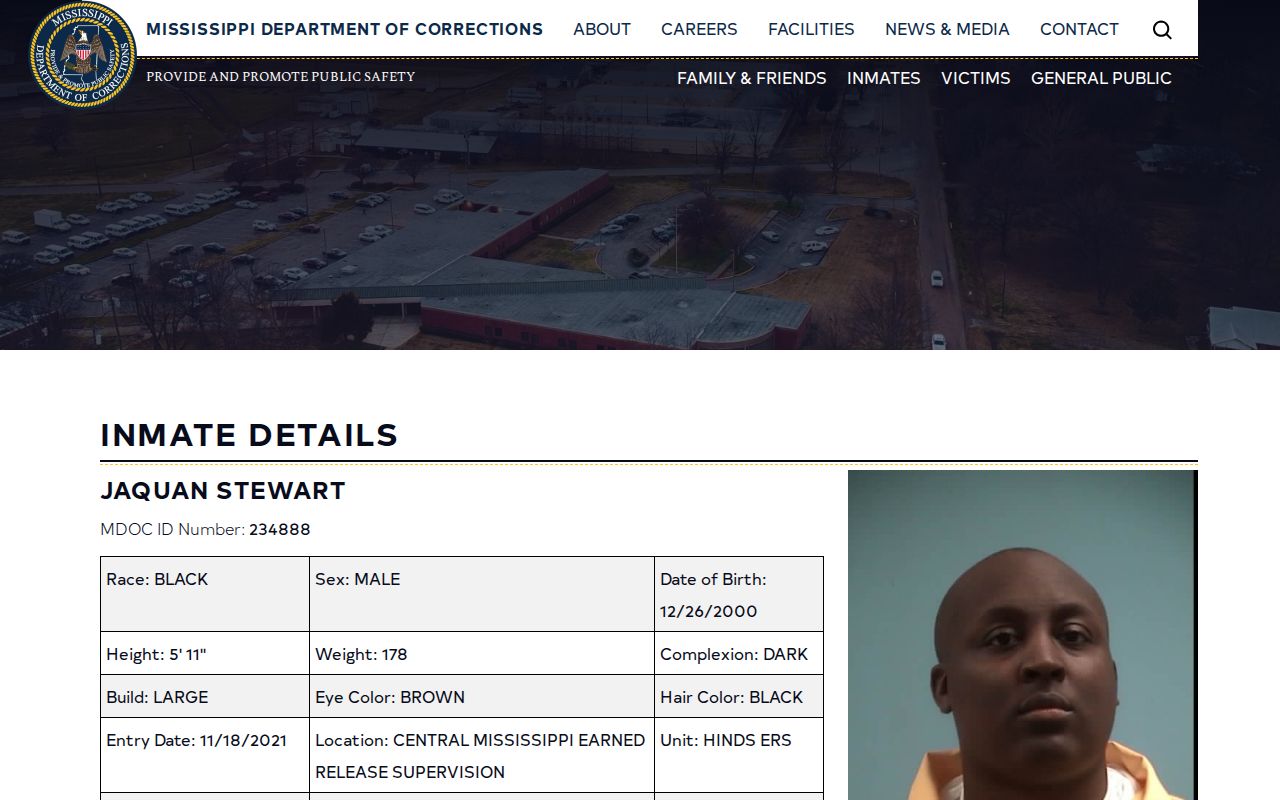
The image demonstrates the label and surrounding sentence information. It does not establish an Amite County release, and every displayed value can change.
| MDOC field | How to read it |
|---|---|
| MDOC ID | Stable state identifier used to reduce name-match errors |
| Location and unit | Current MDOC placement terms, which may include a community or ERS setting |
| Location-change date | Movement date, not automatic proof of discharge |
| Sentence entries | Offense, county, date, and length used to understand the state term |
| Tentative Release Date | Mutable forecast, not the completed release event |
Mississippi Earned Time for Amite
Under Mississippi Code § 47-5-138, an eligible person sentenced after June 30, 1995 may generally earn 4.5 days for each 30 days served. The ordinary allowance is capped at 15 percent of the sentence. That cap produces the common “about 85 percent” shorthand. It is not a safe calculator for one person, and it is not a general parole rule.
Eligibility is controlled by the whole statutory framework. Section 47-5-139 lists exclusions. Credits can also be forfeited after serious rule violations. County jail credit tied to the cause number must be verified and entered correctly. MDOC requests eligible presentence jail time from the county of conviction, so an omitted or disputed credit can affect the forecast until it is resolved.
Trusty time under § 47-5-138.1 is a separate mechanism. A qualifying person in MDOC-designated trusty status may receive a reduction for approved participation, subject to major exclusions. Earned Release Supervision is separate again. ERS may place a person at an approved Mississippi residence while inmate status and MDOC jurisdiction continue.
Note: Earned time, trusty time, ERS, parole eligibility, and final discharge are distinct rules that should never be merged into one estimate.
Why Amite Release Dates Change
A date can move in either direction as MDOC verifies the sentence and later events. The public detail is a forecast built from the information then in the system. MDOC's handbook says the department computes terms, jail credit, parole and ERS eligibility, tentative release or discharge, and maximum dates. The case manager supplies the actual date after required plans are checked.
| Factor | Possible effect | Best confirmation |
|---|---|---|
| County jail credit | Verified presentence days can change the computed term | MDOC Records and cause-number documentation |
| Concurrent or consecutive terms | Sentence structure changes how end points combine | Court judgment and MDOC time computation |
| Credit award or forfeiture | Lawful credit may shorten time; discipline may remove it | MDOC disciplinary and time records |
| Amended court order | A changed sentence can require recalculation | Filed order and updated MDOC record |
| Parole or ERS action | Eligibility, approval, and plan review can alter the custody path | Board or MDOC record and case manager |
| Detainer or receiving hold | Departure from MDOC may lead to another custodian | Holding and receiving agencies |
A changed forecast does not by itself show error. It can reflect a new lawful input. Ask for the computation or event record instead of subtracting a percentage from the sentence.
Amite Parole Dates Are Milestones
Parole eligibility is not release. Current sources describe general thresholds that vary by offense category, but the exact statute, exclusions, offense date, sentence date, enhancements, and consecutive terms control. A person may reach eligibility without receiving a hearing or release. A favorable action may still be followed by plan checks and processing.
No official public Mississippi Parole Board calendar or inmate-by-inmate decisions search was verified. For a particular status, use the Mississippi State Parole Board landing page, contact the Board at 601-576-3520, or request the written decision under its rules. Do not infer a result from an unverified commercial calendar.
Section 47-7-18 permits some qualifying releases at initial eligibility without a Board hearing when each condition is met. Specified violent, sex-offense, and geriatric cases require hearings. Case-plan compliance, discipline, victim hearing requests, supervision agreements, and an approved discharge plan can matter. The statute establishes a process, not a predicted gate-out date.
Amite Tentative Release Date Warnings
Mississippi's public label and its official warning must be read together. The offender detail says Tentative Release Date. The official printable-result disclaimer says release types and dates may differ from information shown on the website. That is why the public date is a useful lead but not final proof.
The MDOC Inmate Handbook places time computation and release processing inside the agency. The case manager supplies the actual date after plans are made, and the person must receive a discharge certificate before release. Processing can take weeks. A forecast that has passed should therefore trigger a records check, not an assumption.
ERS adds one more distinction. An ERS participant can be physically present in the community while still holding inmate status under MDOC jurisdiction. Location, parolee information, the case manager, and the discharge certificate help tell physical placement from full legal discharge.
Confirm Amite Inmate Release Dates
MDOC Records is the strongest routine channel for state time, jail credit, eligibility, actual release, and discharge documentation. The office is at P.O. Box 24388, Jackson, MS 39225, telephone 601-933-2889, and email MDOCRecordsDepartment@mdoc.state.ms.us. A phone inquiry can route a question, but the formal MDOC public-records process must be written because telephone requests are not accepted as records requests.
For county custody, ask the Amite sheriff for the actual release date and time, release mechanism, releasing authority, and destination or receiving agency. Pair that with the relevant court order. If the record says transfer, check the receiving system before calling the event community release.
A VINELink Release Check can add a current movement alert if live Amite participation is confirmed. It remains a notice channel. The discharge certificate, sheriff booking record, court order, and receiving-agency record establish the lasting facts.